
GSTACK: From Pilots to Platforms - Building the Global South’s Scale Engine

After more than a decade of climate innovation, pilots, and demonstrations, one fundamental question remains unresolved:
Why are proven climate technologies still not scaling?
Across energy, water, waste, agriculture, and industrial systems, the world is not short of solutions. Technologies exist. Capital is available. Policy intent is clear. Yet, deployment at scale remains elusive—particularly across the Global South, where the need is most urgent.
The challenge is no longer about innovation. It is about execution at scale.
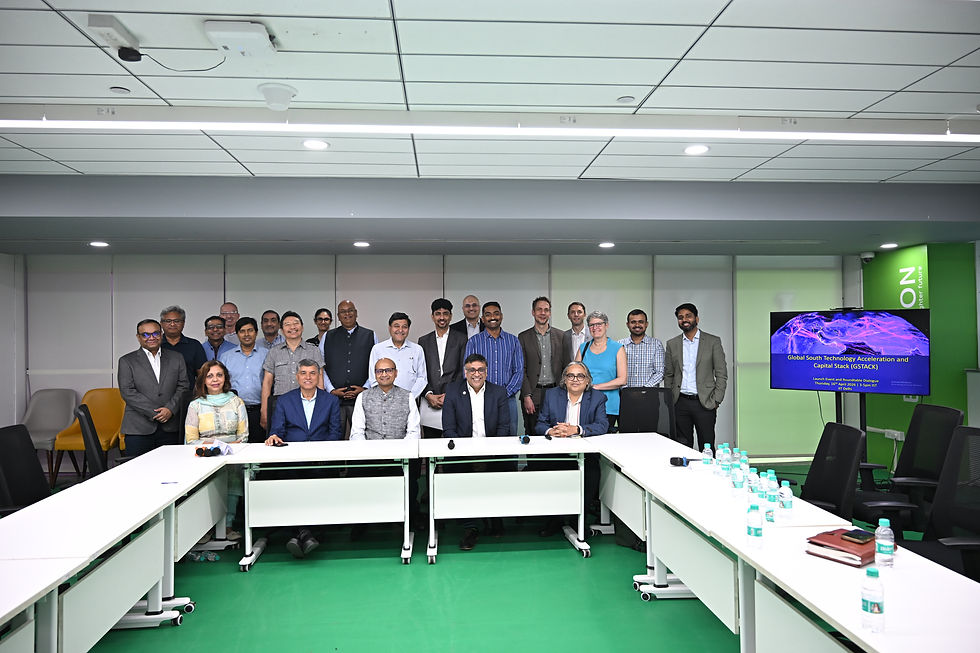
This is the context in which GSTACK — Global South Technology Acceleration & Capital Stack has been launched.
The Missing Layer: From Validation to Scale
Over the past several years, Bharatia, through the Environment & Technology Verification (ETV) programme developed under cGanga at IIT Kanpur, has demonstrated a critical proof point:
Global technologies can be brought into India, rigorously validated, indigenised, and made significantly more affordable.
This has addressed two of the three barriers to scale:
Access to technology
Affordability through localisation
However, a third and more complex challenge remains:
Availability at scale
The transition from First-of-a-Kind (FOAK) deployments to Nth-of-a-Kind (NOAK) scale is where most climate solutions stall. Technologies that succeed in pilots often fail to translate into large-scale platforms due to fragmented execution, lack of integrated financing, supply chain gaps, and absence of structured market pathways.
GSTACK is designed to solve precisely this bottleneck.
What is GSTACK?
GSTACK is not a programme, a fund, or a platform in isolation.
It is an execution architecture.
It integrates the full lifecycle of climate solutions into a single, coherent system:
Technology sourcing, transfer, and indigenisation
Validation through ETV and FOAK deployments
Project development and pipeline creation
Structured finance and capital stack design
Access to capital markets and institutional capital
Replication through NOAK platforms across geographies
This integrated approach ensures that solutions do not remain confined to pilots but evolve into investable, repeatable, and scalable platforms.
As outlined in the launch note , GSTACK brings together technology, project execution, and finance within one coordinated framework—bridging a gap that has historically prevented scale.
India as the FOAK Engine for the World
A central premise of GSTACK is the positioning of India as the world’s FOAK engine for climate solutions.
India offers a unique combination of:
Large-scale demand across sectors
Cost-sensitive markets that drive innovation and efficiency
Strong engineering and industrial capabilities
Policy momentum across climate and infrastructure
Access to both domestic and global capital
When technologies are validated and deployed in India, they undergo a process of cost compression, operational optimisation, and contextual adaptation.
The result is powerful:
Solutions that are not only viable in India—but become globally competitive and scalable across the Global South, and in many cases, even reverse-transferable to developed markets.
GSTACK institutionalises this pathway.
From Fragmentation to Platforms
One of the core structural challenges in climate deployment today is fragmentation.
Technologies are developed in silos
Projects are executed individually
Financing is arranged case by case
Risks are managed inconsistently
Supply chains are not standardised
This fragmentation prevents scale.
GSTACK shifts the paradigm from projects to platforms.
Instead of isolated deployments, it focuses on:
Standardised sector templates across energy, water, waste, and industry
Pipeline aggregation to create scale and visibility for investors
Integrated risk management, including technology, execution, and FX risks
Blended finance structures, guarantees, and credit enhancement mechanisms
Access to listed markets, including InvITs, bonds, and structured vehicles
The objective is to transform climate solutions into a recognisable and investable asset class.
Connecting Technology to Capital
A persistent gap in climate finance has been the disconnect between technology pipelines and capital markets.
While capital is increasingly available—particularly from institutional investors—it requires:
Predictable cash flows
Standardised structures
Risk-adjusted returns
Liquidity and exit pathways
GSTACK addresses this through deep integration with CETFI (Climate & Energy Transition Finance Initiative) frameworks.
This enables:
Structuring of full capital stacks across risk layers
Use of guarantees, insurance, and credit wraps
Development of blended finance models
Creation of listed vehicles and yield platforms
Alignment with institutional mandates
By doing so, GSTACK ensures that climate projects are not only technically viable—but financially investable at scale.
De-Risking Scale
Scaling climate solutions is fundamentally a risk management challenge.
GSTACK systematically addresses multiple risk categories:
Technology risk through ETV validation and FOAK deployment
Execution risk through standardised project development frameworks
Supply chain risk through aggregation and localisation
Market risk through offtake structures and demand creation
Financial risk through structured instruments and capital stack design
FX risk through hedging solutions and currency-aligned financing
This integrated de-risking approach is essential to unlock large-scale capital flows.
The Corridor Model: Scaling Across the Global South
GSTACK is not confined to India.
It is designed as a corridor-based scaling architecture.
Through SITE (Science, Innovation, Technology & Economics) Networks, GSTACK enables:
Technology inflows from developed markets into India.
Validation and scale in India. (Note: This also extends to technologies developed in India.)
Replication across Global South markets through structured corridors
This creates a network multiplier effect, where:
Technologies move faster
Capital flows more efficiently
Markets are connected through execution frameworks
The result is a scalable model for cross-border climate deployment, or other emerging technology asset classes.
New Technology Asset Classes
At its core, GSTACK is about market creation.
The goal is not just to deploy projects—but to enable the emergence of a new category of assets:
Platform-based, standardised, yield-generating climate infrastructure.
By converting fragmented pilots into structured platforms, GSTACK aims to:
Improve liquidity and price discovery
Enable participation from institutional capital
Create scalable investment products
Build confidence in climate as an asset class or alternatively extending to AI, Quantum, Nature and other asset classes.
Who Should Engage
GSTACK is designed for a broad set of stakeholders:
Technology companies seeking market access and scale
Governments and embassies representing Global South markets
Investors and financial institutions looking for structured climate opportunities
Industrial players and developers building large-scale infrastructure
Multilateral and development agencies enabling blended finance
For each of these stakeholders, GSTACK provides a pathway from intent to execution.
The Road Ahead
The launch of GSTACK marks a shift in how climate solutions are approached.
The conversation is no longer about:
Whether technologies exist
Whether capital is available
The focus is now on:
How to systematically scale what already works.
GSTACK provides that system.
It brings together policy, technology, finance, and execution into a single architecture—designed to deliver scale, speed, and replicability.
Bharatia initiates collaboration with Bhutan as the first country in the GSTACK framework.


Thank you for sharing this — GSTACK's journey from pilots to platforms is a compelling blueprint for how the Global South can build scalable technology infrastructure that drives genuine economic transformation rather than remaining dependent on imported solutions. Managers tracking these emerging opportunities are turning to a financial analysis and modeling course & workshop for managers in Manama, Bahrain — where data-driven investment analysis, market modeling, and emerging economy strategy are explored with genuine professional depth.
Thank you for sharing this thought-provoking topic. GSTACK’s transition from pilot initiatives to scalable platforms highlights the growing emphasis on digital public infrastructure, innovation ecosystems, and technology-driven development across the Global South. It also demonstrates how successful scaling requires robust funding models, measurable outcomes, and long-term strategic planning to transform promising concepts into sustainable platforms. Understanding the economic impact and scalability of such initiatives is a key focus of the financial analysis and modeling seminar & course for executives in Manama, Bahrain, where participants explore forecasting techniques, investment evaluation models, and data-driven decision frameworks used to assess large-scale digital transformation and development projects.