
India–Slovenia Trade & Investment Landscape
Updated: Sep 6
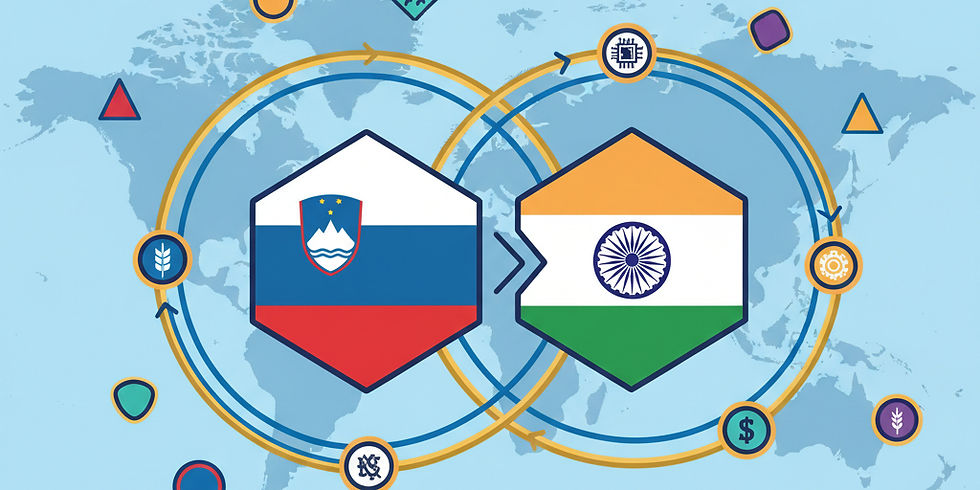
Featured in Bharatia | India-Slovenia SITE Network Intelligence — Issue 1, 04 September 2026
Trade Has Crossed US$1 Billion. Investment Must Now Catch Up.
The India–Slovenia economic relationship has reached an important milestone.
Bilateral merchandise trade crossed US$1 billion for the first time in FY2025–26, reaching US$1.064 billion. India's exports to Slovenia rose to US$765.17 million, while imports from Slovenia stood at US$298.83 million. Total trade increased 25.4% in a single year, from US$848.83 million in FY2024–25.
The direction is encouraging. But the numbers also reveal where the relationship needs to go next.
Goods trade is growing strongly. Services are beginning to expand. Investment remains disproportionately small.
The next phase of the corridor should therefore be less about celebrating the US$1 billion milestone and more about converting growing trade into investment, joint ventures, co-manufacturing, technology partnerships and deeper integration between the two economies.
Merchandise Trade: A Stronger Base
The five-year trajectory shows that the bilateral trading relationship has become materially larger.

The composition of this trade is arguably more important than the headline number.
India's leading exports include pharmaceuticals at US$136.02 million, defence equipment at US$107.70 million, industrial machinery at US$99.63 million and organic chemicals at US$81.58 million. Together with other manufactured products, the top ten categories account for nearly 79% of Indian exports to Slovenia.
Trade in the opposite direction reflects Slovenia's industrial strengths. India's imports from Slovenia are concentrated in industrial machinery, electrical equipment, organic chemicals, iron and steel and precision instruments, with industrial machinery alone accounting for US$87.43 million.
This is important.
The bilateral relationship is not simply an exchange of commodities. Both countries are already trading manufactured, industrial and technology-intensive products.
That provides a stronger foundation for the next stage: moving from buying and selling products towards integrated value chains, technology partnerships and co-production.
Services: The Next Growth Frontier
Services present a different picture — smaller, but growing steadily.

Total bilateral services trade increased from US$150 million in 2021 to US$223 million in 2024, an increase of almost 49%.
India's services exports to Slovenia grew from US$81 million to US$127 million over the period, while Slovenian services exports to India increased from US$69 million to US$96 million.
The opportunity now is to broaden the services relationship into higher-value areas where the capabilities of the two countries intersect.
These include AI and digital engineering, industrial automation, cybersecurity, Industry 4.0, engineering R&D, pharmaceutical research and regulatory services, energy systems and applied research. The underlying analysis identifies these knowledge-intensive services as one of the largest underdeveloped areas in the bilateral relationship.
This could become an important second pillar alongside merchandise trade.
Investment: The Missing Link
This is where the biggest gap becomes visible.
Despite merchandise trade exceeding US$1 billion, recorded Slovenian FDI inflows into India were only US$15.96 million between March 2025 and March 2026, according to the DPIIT data used for this edition.
Comparable official country-specific data for Indian FDI into Slovenia is not publicly available and will require more research.
The important conclusion is therefore not a precise comparison of investment in each direction. It is that bilateral investment remains modest relative to the commercial relationship. That matters because trade alone will not create the deeper strategic partnership described in this newsletter.
If Slovenia is to become a meaningful European platform for Indian companies, that should eventually translate into Indian investment in manufacturing, logistics, R&D, pharmaceuticals and technology businesses in Slovenia.
Likewise, if India is to become a commercialisation and Global South platform for Slovenian companies, that should translate into Slovenian investment in Indian manufacturing, joint ventures, technology localisation, projects and operating businesses.
The next milestone for the corridor should therefore not simply be another increase in trade.
It should be a visible increase in two-way investment.
Where Could the Next Wave Come From?
The current trade profile already points towards where deeper economic integration could emerge.
In advanced manufacturing, Indian companies can combine manufacturing scale with Slovenian precision engineering, automation and access to European industrial value chains.
In pharmaceuticals and biotechnology, India's manufacturing and API capabilities can combine with Slovenian R&D, complex formulations and European regulatory expertise.
In automotive and mobility, the two countries can connect India's large manufacturing ecosystem with Slovenia's position within European automotive supply chains.
In energy and industrial technologies, Slovenian capabilities in areas such as smart metering, grid technologies and engineering can address rapidly expanding Indian requirements.
And in digital and knowledge services, India's software and engineering depth can increasingly complement Slovenia's industrial and research capabilities.
These are not simply sectors in which bilateral trade can increase. They are areas in which the form of the economic relationship can change.
From US$1 Billion in Trade to a Bilateral Investment Corridor
Crossing US$1 billion in merchandise trade is significant. But it should be viewed as a foundation, not the destination.
The more important question is what the next US$1 billion of economic activity looks like. If it consists primarily of additional imports and exports, the relationship will certainly become larger.
If it comes through joint ventures, manufacturing, technology licensing, R&D, projects, services and investment, the relationship will become deeper. That is the larger opportunity.
Trade has established the corridor. Investment, technology and co-production can now transform it.
This article appears in Bharatia | India-Slovenia SITE Network Intelligence — Issue 1
Explore the complete edition for insights on the India–Slovenia strategic partnership, bilateral trade and investment, technology and innovation opportunities, the SITE corridor roadmap and pathways for deeper commercial collaboration. → Read the full edition


Comments