
The India–Slovenia SITE Network
Updated: Sep 6

Featured in Bharatia | India-Slovenia SITE Network Intelligence — Issue 1, 04 September 2026
Turning Bilateral Opportunity into Commercial Activity
India and Slovenia already have the foundations of a bilateral relationship: diplomatic engagement, growing trade, institutional cooperation and existing links between businesses, universities and research organisations.
The opportunity now is to build the implementation layer.
The India–Slovenia SITE Network — Science, Innovation, Technology & Economics — has been established by Bharatia to turn bilateral opportunities into tangible economic activity.
SITE is not intended to be another conventional business network or forum for dialogue. Its starting point is deliberately different:
Start with a problem to solve or an opportunity to pursue — together.
Then identify and bring together the technologies, businesses, research institutions, project owners, policymakers and capital required to make it happen.

From Opportunity to Implementation
A SITE opportunity can begin in either country — and at almost any point in the economic value chain.
A Slovenian technology company may have a proven solution that addresses a major Indian requirement but needs localisation, manufacturing, market access or its first deployment in India.
An Indian company may be looking for specialised European technology, an R&D partner, an industrial collaboration or a platform from which to access European markets.
A university or research institution may have expertise capable of addressing a real-world challenge but require industry and implementation partners to take it beyond research.
A city, utility or industrial company may have a problem requiring technologies and capabilities from both countries.
Or Indian and Slovenian partners may identify an opportunity to develop something together and subsequently take it into Europe, India or the wider Global South.
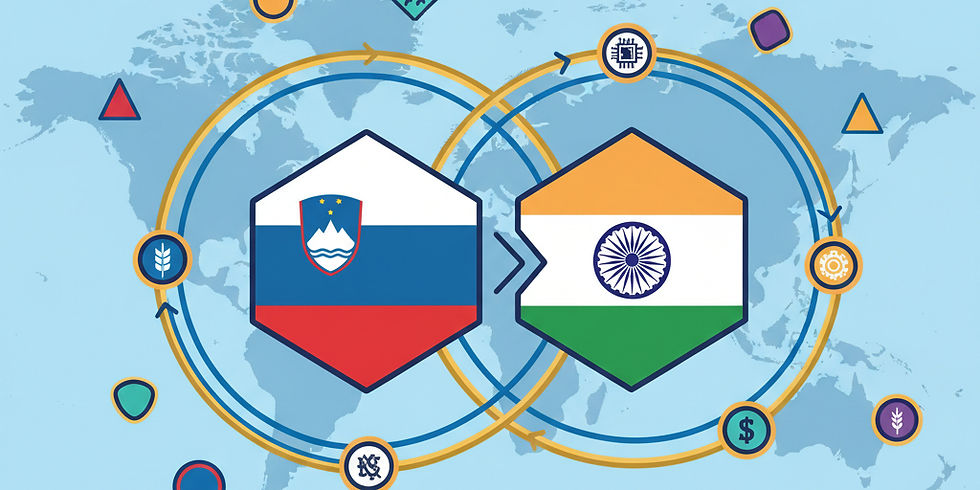
SITE provides the bilateral corridor through which these individual pieces can be connected to Bharatia's wider implementation ecosystem:
This is not necessarily a rigid sequence. Opportunities can enter at different points and require different combinations of capabilities. The purpose is to provide the infrastructure needed to move from problem or opportunity to commercialisation, deployment, finance and scale.
The Bharatia Implementation Ecosystem
Through SITE, relevant Indian and Slovenian organisations can be brought together around that problem or opportunity.
Grand Challenges provide a starting point on the demand side: a government, city, utility, industry or institution identifies a significant problem requiring new technologies, capabilities or commercial models. Read more
Where an international technology requires an Indian commercialisation pathway, ETV — Environment & Technology Verification — can support its validation, localisation, market readiness and progression towards deployment. Read more
Where the opportunity requires a real-world first deployment, FOAK — First-of-a-Kind — provides the pathway for developing the project, assembling the partners and demonstrating the commercial model. Read more
Where capital is required, CETFI — the Climate & Energy Transition Finance Initiative — can connect technologies, projects and commercial models with appropriate investment and financing structures. Read more
And where technologies, projects or models successfully developed through India have relevance elsewhere, GSTACK provides a pathway towards replication and scale across the wider Global South. Read more
Grand Challenges → SITE → ETV → FOAK → CETFI → Scale → GSTACK
SITE therefore does not operate in isolation. It provides the bilateral corridor connecting Slovenian and Indian capability into a wider implementation architecture.
What Can Be Developed Through SITE?
The objective is to build a growing portfolio of bilateral activity rather than a calendar of bilateral meetings.
This can include Grand Challenges requiring new solutions; technology commercialisation and ETV pathways; joint
R&D and innovation; manufacturing and localisation partnerships; FOAK projects; trade and investment opportunities; industrial and supply-chain partnerships; financing through CETFI; and joint propositions capable of scaling into third markets through GSTACK.
The corridor can operate in both directions.
For Slovenian companies, India can provide a pathway from specialised innovation to localisation, deployment, manufacturing and scale.
For Indian companies, Slovenia can provide access to specialised technologies, research, advanced manufacturing capabilities and European markets.
And where the combination is compelling, Indian and Slovenian partners can jointly develop solutions for markets beyond either country.
Building on Existing Foundations
SITE does not start from zero.
India and Slovenia already have cooperation across trade, science, technology and academia. The bilateral framework includes 19 agreements and MoUs concluded between 1993 and 2024, while the 10th Joint Committee on Trade and Economic Cooperation met in New Delhi in November 2025.
There are also examples of collaboration moving beyond institutional dialogue. The 2019 IIT Kanpur–Space-SI MoU, developed around applications supporting the Clean Ganga programme, demonstrates how Slovenian capabilities can be connected to specific Indian challenges.
The task now is to create more such opportunities — systematically and across sectors.
Bring Something to the Corridor
SITE is therefore an invitation to participate — but participation should have a purpose.
Bring a Grand Challenge: A government, city, utility, industry or institution with a problem requiring technology, expertise or a new approach.
Bring a Technology: A proven capability that can be commercialised, localised and deployed — including technologies that can progress through ETV.
Bring an Opportunity: A manufacturing, research, market-access or commercial proposition that Indian and Slovenian partners can pursue together.
Bring a Project: A real deployment around which technologies, partners and commercial models can be assembled — including potential FOAK projects.
Bring Capital: Investment and finance capable of taking technologies and projects from deployment towards commercial scale, including opportunities connected through CETFI.
Bring a Market: An opportunity to take proven solutions beyond their first deployment — across India and Europe, and through GSTACK, into the wider Global South.
From Corridor to Scale
The India–Slovenia SITE Network is therefore more than a mechanism for connecting organisations in two countries.
It is the corridor through which bilateral opportunities can enter Bharatia's wider implementation ecosystem.
A problem can become a Grand Challenge. A technology can progress through ETV. An opportunity can become a FOAK project. A project can connect with capital through CETFI. And a successful solution can create a pathway towards wider Global South deployment through GSTACK.
Not every opportunity will require every part of this architecture. But the objective remains the same: to connect the capabilities required to move from bilateral opportunity to commercial activity and measurable impact.
The measure of SITE will not be how many people join the network. It will be what the network gets done.
This article appears in Bharatia | India-Slovenia SITE Network Intelligence — Issue 1
Explore the complete edition for insights on the India–Slovenia strategic partnership, bilateral trade and investment, technology and innovation opportunities, the SITE corridor roadmap and pathways for deeper commercial collaboration. → Read the full edition


Comments